
Dream Talking, Part 4
Learn to remember your dreams. Open communication with your subconscious mind. Gain insight into who you are so you can effectively interpret your dreams and get the most of your journey through life.
Dream Talking Online Course – Part 4
Part 4
The Language of Dreams
You can listen or read to begin …
This course has been recorded for hands-free easy listening, or you can read the content below. Please complete each stage before proceeding to the next. Repeating any stage is encouraged if you feel the need to.
Part 4 – The Language of Dreams
We have all usually remembered dreaming at some point in our lives, and so we all know dreams can be wonderful, complex, simple or just plain confusing.
The context or experience of your dreams originates from the meaning, relevance and context you attach to events, people, places, objects and your feelings. Even simple everyday actions can be reimagined by your mind to suit a dream if the emotional and psychological themes match the message.
For example – in a dream, the way you are dressed may be highlighted to show you are dressed in a certain colour that has a meaning specifically to you. The colour can represent a feeling, a memory or a recent experience. Or, another dream may present a situation where you are walking swiftly and easily along a footpath, and can be more generally accepted as a reflection of your movement through life as flowing positively and without obstacle.
Some symbols are more universal, and some are very personal.
- We all share many of the same symbols in dreams in the same way we share the same emotions or concepts in life
- The key to interpretation is to identify how you relate to what you think, and to how you relate to your surroundings, in order to clarify their meaning to you
This is why we have to know what things mean to us, which means knowing more about ourselves.
Remember, a dream is your subconscious and inner mind communicating with you. Telling you what is going on, helping you understand your response and your relationships to everything around you. Because your subconscious self only knows the truth and it has no preferences. It cannot lie. It just wants the best for you. Therefore it uses your genuine feelings and responses through icons, images, scenarios and moods, symbols, relationships and storylines.
This part of the program is all about symbols. The first exercise is about how you interpret common dream symbols. The reason for this is to establish a dialogue of acceptance to your subconscious, so when you go to bed after completing this exercise your subconscious will review and understand that you are opening the window for clearer communication.
For the best outcome, please complete Steps 1 and 2 together as they both relate to how you interpret and identity all kinds of symbols.
1. Recommendations before you begin…
2. Write the questions and answers in a Notebook or Personal Journal
You will use these document throughout this course for activities, personal reflections, dream symbology, questions & answers. Hint: hand-written Q&As will give you the best results (learn why soon),
2. Write about how you FEEL
No matter how strange it seems, ALL dream componentes have context, meaning and reason. How it feels is the MOST important thing of all. For example, if you see a “Mountain” and it feels “happy” then write it down. There is always a meaning in feelings which is why the mind is dreaming it, and showing it to you!
Recommended items and course suggestions so you can get the best results from this course…
- Something to write on. This should be a notepad and pen. When we write with a pen or pencil we engage the brain in ways typing and touching a screen do not. However, use of a phone, tablet, computer or other device can still be used.
- Before you sleep. It is also highly recommended to write in a journal or diary before going to sleep; this allows you to sort your feelings and empty your mind of thoughts from the day. Just as in the Dream Talking program, working with yourself often creates a greater connection inwardly and can enhance dream clarity.
- A Personal Journal or Notepad. The activities in this course are best completed when hand-written. If possible, record on your preferred written format. If you are not able to write or journal you can make notes on your digital device just as easily.
- Note 1: It is strongly recommended to turn off as many distractions as possible when completing this program, such as music or television (and even your phone if you are not using it to read the course notes).
- Note 2: It is strongly recommended to avoid using all device or screen technology at least 30 mins before going to bed. This allows your brain to relax and prepare for sleep.
Download or View
-
This PDF contains space for journalling, recording dreams and also activity sheets for later parts of this course
-
You can still use your own journal (this is just to make it easier if you don’t have one)
-
You can view the PDF activity sheets on-screen or you can print them out
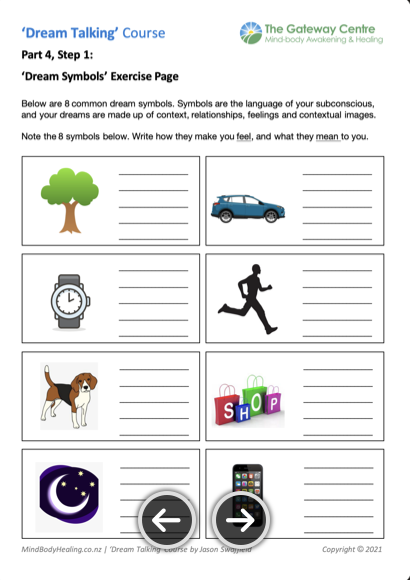
Part 4, Step 1
Dream Symbols
You can listen or read to begin …
This course has been recorded for hands-free easy listening, or you can read the content below. Please complete each stage before proceeding to the next. Repeating any stage is encouraged if you feel the need to.
Part 4, Step 1 – Dream Symbols
In this first exercise there are 8 symbols already drawn on the first sheet. Of course there are literally millions of symbols your subconscious can use to create dreams, but these 8 will form a baseline and a Key to your Real intention – remembering your dreams.
- The exercise sheet is available as a PDF media file below
- Please download and print it out because there will be writing and drawing involved
- I always encourage you to handwrite on these pages. When we handwrite, we activate the brain in a fashion that actually activates your neural activity, thought processing and memory centres to flow more naturally. Typing digitally does not
- So, please take the first sheet with the pre-filled 8 symbols and complete the exercise before moving on to Part 4, Step 2
- As long as you do Step 2 on the same day, you will get the maximum benefit possible form this section of the program
Enjoy the exercise!
Part 4, Step 2
Your Dream Symbols
You can listen or read to begin …
This course has been recorded for hands-free easy listening, or you can read the content below. Please complete each stage before proceeding to the next. Repeating any stage is encouraged if you feel the need to.
Part 4, Step 2 – Your Dream Symbols
Now we are going to look at your own personal selection of symbols. For this exercise, I want you to choose 8 symbols of your own.
- You will draw the symbol, and then write what that symbol means to you. Don’t worry, it’s not about how well you can draw, it only matters what the symbol means to you
- They can be any symbols at all, no matter what. Your symbols can be objects or people, They can be memories or places. The only thing that matters is that you choose them. No matter what it is, if you want to put it in there then that is what you need to do. The only thing to remember is that you include a description that is short – just a few words will do.
- Make sure it is concise and completely accurate so you are writing how you feel about the symbol, and what it means to you
- Once again, the exercise sheet is available as a PDF media file right here. Please download and print because, especially is this step, there is writing and also drawing involved
As I mentioned in Step 1, it is important to handwrite and hand draw your answers.
- When we handwrite, we activate the brain in a fashion that actually activates your neural activity, thought processing and memory centres to flow more naturally. Typing digitally does not
- When you are finished, don’t move on to Part 5 until tomorrow
- If you want to review these pages before you go to bed, I encourage you to do so. You might even want to use another sheet and identify another 8 of your own symbols. If you do leave it at 2 sheets maximum in any one session, as groups of 8 or 16 are very effective number sets when it comes to getting Real about remembering your dreams
Enjoy your exercise!