
Dream Talking, Part 1
Learn to remember your dreams. Open communication with your subconscious mind. Gain insight into who you are so you can effectively interpret your dreams and get the most of your journey through life.
Dream Talking Online Course – Part 1
Part 1 – Commencement Questionnaire
You can listen or read to begin …
This course has been recorded for hands-free easy listening, or you can read the content below. Please complete each stage before proceeding to the next. Repeating any stage is encouraged if you feel the need to.
Part 1 – Commencement Questionnaire
Recalling dreams is like any other objective we want to achieve – it takes passion and intent (you have plenty of that as you are here doing this course!) as well as some guidance.
It is about learning why we perhaps are not achieving it at the moment, and then doing some training on how to turn that around.
Like most things, success is a state of mind. Our mindset effects our lifestyle and our choices. A powerful and calm mind can achieve miraculous things.
We will use a similar questionnaire at the end of the program. These two questionnaires will help you understand yourself now, and who you become by the end of the program. You will also be able to se how you can continue to improve your dream recall and your sense of inner awareness and self knowledge by viewing what has changed, and how.
Now please complete this Commencement Questionnaire, and record your answers in a journal or notebook.
Commencement Questionnaire
1. Recommendations before you begin…
2. Write the questions and answers in a Notebook or Personal Journal
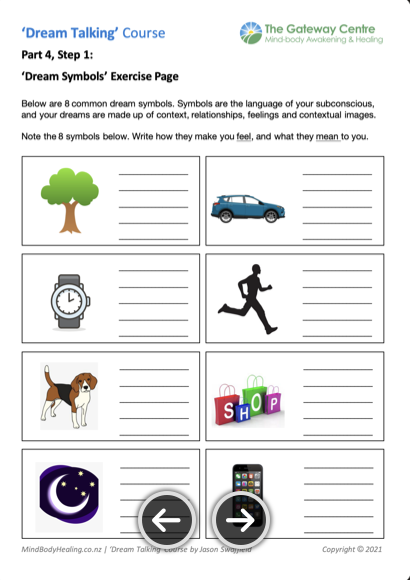
You will use these document throughout this course for activities, personal reflections, dream symbology, questions & answers. Hint: hand-written Q&As will give you the best results (learn why soon),
2. Write about how you FEEL
No matter how strange it seems, ALL dream componentes have context, meaning and reason. How it feels is the MOST important thing of all. For example, if you see a “Mountain” and it feels “happy” then write it down. There is always a meaning in feelings which is why the mind is dreaming it, and showing it to you!
Recommended items and course suggestions so you can get the best results from this course…
- Something to write on. This should be a notepad and pen. When we write with a pen or pencil we engage the brain in ways typing and touching a screen do not. However, use of a phone, tablet, computer or other device can still be used.
- Before you sleep. It is also highly recommended to write in a journal or diary before going to sleep; this allows you to sort your feelings and empty your mind of thoughts from the day. Just as in the Dream Talking program, working with yourself often creates a greater connection inwardly and can enhance dream clarity.
- A Personal Journal or Notepad. The activities in this course are best completed when hand-written. If possible, record on your preferred written format. If you are not able to write or journal you can make notes on your digital device just as easily.
- Note 1: It is strongly recommended to turn off as many distractions as possible when completing this program, such as music or television (and even your phone if you are not using it to read the course notes).
- Note 2: It is strongly recommended to avoid using all device or screen technology at least 30 mins before going to bed. This allows your brain to relax and prepare for sleep.
Download or View
-
This PDF contains space for journalling, recording dreams and also activity sheets for later parts of this course
-
You can still use your own journal (this is just to make it easier if you don’t have one)
-
You can view the PDF activity sheets on-screen or you can print them out
Disclaimer & Terms of Use.